We may earn a commission when you buy through links on this page, at no extra cost to you. How this works.
Grow lights for houseplants range from around $25 for basic LED panels to well over $300 for high-end systems, but most apartment dwellers don't need to stretch their budget to the upper end. If you're renting with limited natural light and want your plants to thrive without constant guesswork, this guide will help you make sense of the options.
The grow light market is full of confusing terminology - full spectrum, PAR values, photoperiod control - and it's easy to overspend on features that won't make a difference for a small collection of pothos, snake plants, or succulents on a shelf. This guide cuts through the marketing language and focuses on what actually matters: spectrum type, wattage, coverage area, and placement. You'll learn how to match a grow light to your space and plant types without paying for specs you don't need.
Whether you're trying to keep a few low-light plants healthy through winter or hoping to support flowering species year-round, the right grow light comes down to understanding a handful of practical tradeoffs. We'll walk through each decision point so you can choose with confidence and avoid common pitfalls that waste money or leave your plants struggling.
Who This Guide Is For
This guide is written for apartment and small-space dwellers who want to keep a modest collection of houseplants thriving indoors. If you're working with limited natural light - particularly north-facing windows, interior rooms, or spaces shaded by neighboring buildings - and you maintain between three and ten plants, this is for you.
We assume you're renting or otherwise unable to install hardwired fixtures, so all recommendations focus on plug-in solutions that require no electrical work. Budget is set at under $50 per light, and the emphasis is on straightforward setup: clip-on, desktop, or freestanding fixtures that you can position and adjust without tools.
This is not a guide for commercial growers, greenhouse operators, or anyone cultivating high-light tropical species or fruiting plants at scale. Instead, it addresses the practical constraints of urban indoor gardening - limited floor space, landlord restrictions, and the need for unobtrusive, energy-efficient lighting that fits into a living room, bedroom, or kitchen corner.
If you're looking to supplement weak daylight for common foliage plants like pothos, snake plants, or philodendrons, and you want clear guidance on spectrum, wattage, and placement without wading through commercial horticultural jargon, you're in the right place.
What Actually Matters in a Grow Light
Choosing a grow light becomes simple once you understand the four factors that actually affect plant growth: spectrum, wattage, coverage area, and form factor.
Spectrum refers to the range of light colors a bulb emits. Full-spectrum lights produce white light that includes all wavelengths plants use, making them ideal for foliage houseplants like pothos, monstera, and philodendron. These plants evolved under forest canopies where they receive filtered sunlight across the entire spectrum. Red-and-blue-only LED lights appear purple and work well for flowering or fruiting plants, but they create an unnatural glow in living spaces and may not support the balanced growth most houseplants need.
Wattage is where confusion starts. Marketing materials often list "equivalent wattage" (like "100W equivalent"), but what matters is actual power draw - the real watts the light pulls from your outlet. A light advertised as 100W equivalent might draw only 20 actual watts. For low-light houseplants, aim for 20-30 actual watts per square foot of plant coverage. Medium-light plants need 30-50 watts, and high-light plants (succulents, herbs) need 50-80 watts per square foot. Always check the product specs for "actual power consumption" or "input wattage."
Coverage area tells you how much growing space the light can effectively illuminate. A light might be bright directly underneath but weak at the edges. Manufacturers usually list coverage area in square feet, often giving two numbers: one for vegetative growth and one for flowering. For houseplants, use the vegetative coverage number. A typical 2-foot-wide shelf holding three to four medium plants needs roughly 2-4 square feet of coverage.
Form factor determines how you'll position the light. Clip-on lights work for single plants or tight spaces but offer limited adjustability. Hanging panel lights cover larger areas and work well above shelves or plant stands, though they require ceiling hooks or suspension systems. Standing lights with adjustable goosenecks fit between furniture and allow you to direct light exactly where needed, but they take up floor space. Choose based on your space constraints and whether you're lighting one plant or a collection.
Understanding these four factors lets you evaluate any grow light on its actual capabilities rather than packaging claims. A full-spectrum light with 25 actual watts and 2 square feet of coverage will always outperform a red-blue light with vague "150W equivalent" labeling and no coverage specification.
Your Plant Light Needs: Quick Assessment
- Count your plants that need supplemental light
- Measure the shelf or table area they occupy (length and width)
- Check if you have ceiling hooks, shelf edges, or desk space for mounting
- Note your plant types: foliage-only or any flowering/fruiting varieties
- Decide if you need a timer or can manually control lighting
- Set your budget ceiling before browsing
Understanding Form Factors: Clip, Hang, or Stand
The physical design of your grow light determines where you can place it, how much area it covers, and whether it suits your living situation. Each form factor comes with practical tradeoffs that matter in apartments and rental homes.
Clip lights attach to shelves, desks, or windowsills using a spring-loaded clamp. They work well for single shelves or small groupings of plants on a bookcase. Most clip models have a flexible gooseneck or adjustable arm that lets you position the bulb 6 to 18 inches from foliage. The main limitation is coverage: clip lights typically illuminate a circular area 12 to 24 inches wide, making them a poor choice for spreading multiple plants across a long table. They also require a stable edge at least half an inch thick to grip securely. If your furniture has rounded edges or thin lips, the clamp may not hold.
Hanging lights suspend from the ceiling or overhead brackets and deliver more uniform coverage across wider shelves or benches. A single hanging panel can cover 24 to 48 inches of horizontal space, depending on wattage and height. The tradeoff is installation: you need either an existing ceiling hook, permission to drill, or a tension rod system that fits your space. In rentals where modifications are restricted, hanging options may not be feasible. Hanging lights also fix the coverage zone in one spot, so rearranging plants or furniture becomes less convenient.
Standing lights use a tripod or weighted base and require no wall anchors or clamps. You can move them from room to room and adjust height using a telescoping pole or adjustable legs. This portability makes them ideal for renters and for rotating seasonal setups. The downside is floor space: a tripod base typically occupies a footprint 18 to 30 inches wide, and the legs can interfere with furniture placement or create a trip hazard in tight quarters. Standing lights also tend to be top-heavy, so stability matters if you have pets or children.
Match the form factor to your furniture and lease constraints. If you have a single bookshelf with accessible edges, a clip light keeps setup simple. If you have a long plant bench and ceiling access, a hanging panel provides better efficiency. If you move frequently or cannot modify walls, a standing light offers the most flexibility despite the floor-space cost.
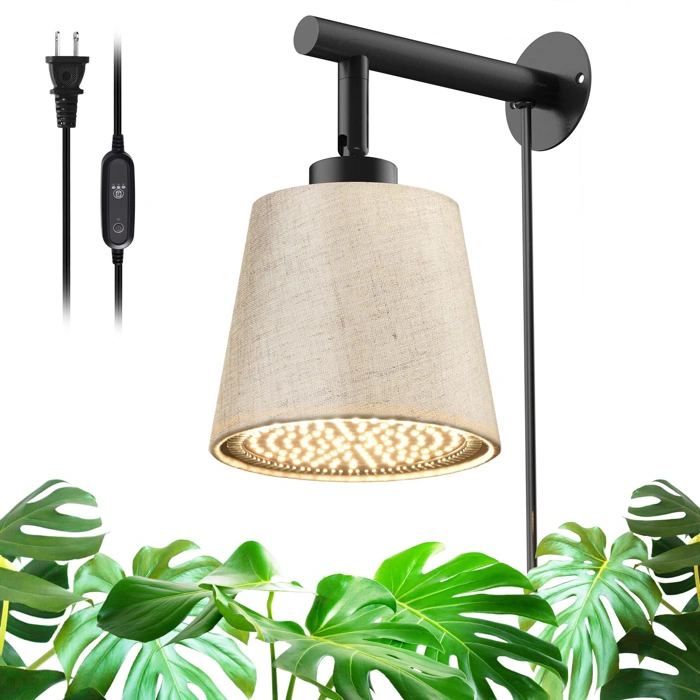
Bstrip 25W Full Spectrum Wall-Mounted Hanging Grow Light with Timer
The Bstrip 25W Full Spectrum Wall-Mounted Hanging Grow Light with Timer offers a practical solution when shelf or desk space is limited. Priced at $35.49, this hanging fixture lets you suspend light over a wider area without claiming valuable surface real estate, making it particularly useful for multi-plant shelves or narrow windowsill setups.
The built-in timer automates daily light cycles, which helps maintain consistent exposure without manual switching. The 25-watt output and full-spectrum design support a range of houseplants, though performance will depend on your specific species, shelf width, and how far you suspend the fixture above the foliage.
Installation requires hooks, brackets, or adhesive strips capable of supporting the unit's weight. Measure your shelf width before purchasing to confirm the fixture will span your intended coverage area. Because the light hangs, you'll need clearance above the shelf and should plan for cord management.
This design works best when you want to cover multiple smaller pots arranged side by side, or when desk lamps would crowd your workspace. If you prefer a no-installation option or need a more portable solution, a clamp or freestanding lamp may be a better fit. The Bstrip balances price, automation, and space efficiency for users comfortable with simple mounting.
- ✅ Frees up desk and shelf surface space
- ✅ Built-in timer for automated daily cycles
- ✅ Priced at $35.49 with 4.4/5 rating
- ✅ Covers wider areas for multi-plant shelves
- ⚠️ Requires installation hardware (hooks or strips)
- ⚠️ Needs overhead clearance and cord management
- ⚠️ Coverage depends on shelf width and mounting height
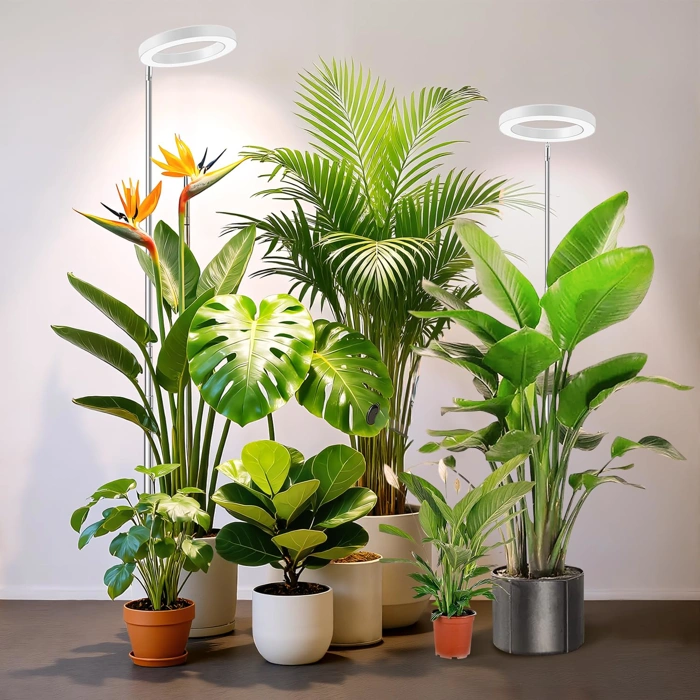
Full Spectrum LED Grow Light with Timer, 3 Color Modes, Height Adjustable (2 Pack)
This two-pack LED grow light offers an approachable entry point for anyone starting a small houseplant collection across multiple windowsills or shelves. Priced at $29.69 for the pair, it provides flexibility without a large upfront cost.
Each fixture features three color modes - warm, cool, and full spectrum - so you can switch between promoting vegetative growth, flowering, or general maintenance depending on the stage of your plants. The timer function automates daily light cycles, reducing the need to manually turn lights on and off each morning and evening.
Height adjustability is the standout feature for beginners. The telescoping arm lets you position the light close to seedlings or low-profile succulents, then raise it as plants mature. This adaptability works well if you're experimenting with different species or starting seeds indoors before transplanting.
The two-pack configuration is particularly useful if you want to cover separate areas - perhaps one unit over a tray of propagating cuttings and another over a small herb collection. It spreads your lighting investment across more square footage than a single larger fixture would.
Build quality is functional rather than premium. The clamp-style base works on shelves and tables up to about two inches thick, and the gooseneck arm holds position once adjusted, though it may loosen slightly over time with frequent repositioning.
This setup suits apartments or starter collections where you need basic supplemental light without specialized intensity controls. If you're growing high-light tropical plants or aiming for dense flowering, you may eventually want a fixture with higher wattage and PAR output, but for leafy houseplants, pothos, and beginner-friendly species, this pair offers solid coverage at a budget-friendly price.
- ✅ Two-pack under $30 spreads coverage across multiple small areas
- ✅ Height-adjustable arm accommodates seedlings through mature plants
- ✅ Three color modes for different growth stages
- ✅ Built-in timer automates daily light cycles
- ✅ Clamp base fits standard shelves and tables
- ⚠️ Gooseneck may loosen with frequent repositioning
- ⚠️ Lower wattage limits use with high-light or flowering plants
- ⚠️ Clamp fits surfaces up to about two inches thick
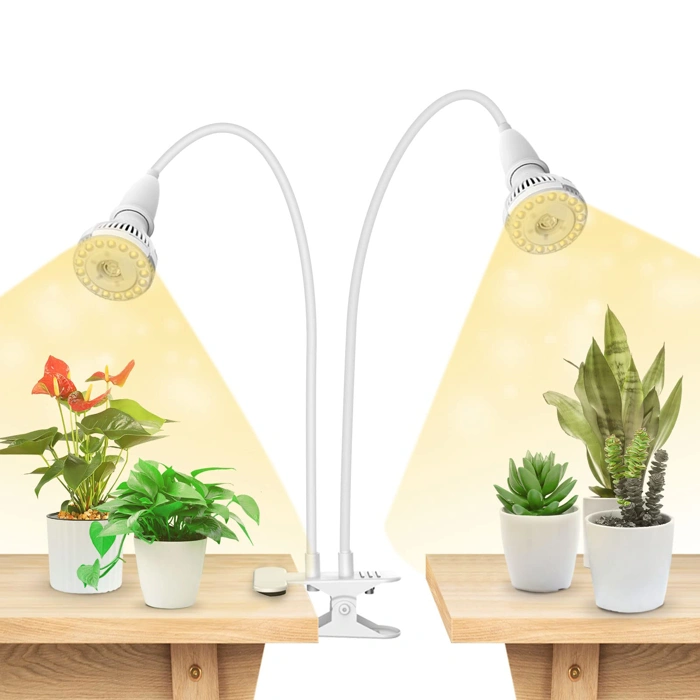
SANSI 20W Full Spectrum Clip-on Gooseneck LED Grow Light with Ceramic Tech
The SANSI 20W Full Spectrum Clip-on Gooseneck LED Grow Light offers a compact, flexible solution for single plants or small clusters on desks, shelves, or countertops. Its gooseneck design allows you to adjust the angle and distance, making it easy to spotlight one statement plant or concentrate light on a small grouping without rearranging your furniture.
This model uses ceramic heat dissipation technology, which helps the fixture run cooler than traditional plastic-housed LEDs. The clip mount attaches to shelf edges, desk lips, or plant stands, keeping the light stable without taking up surface space. At the listed output, it delivers enough intensity for low-to-medium light plants within a focused footprint, but it won't cover large areas or tall multi-tiered shelving.
The full spectrum output supports foliage growth and can help maintain color in variegated plants when natural light is limited. Because the light is close to the canopy, you can place it within the listed size of leaves, adjusting as plants grow. The gooseneck arm stays put once positioned, so you won't need to readjust daily.
This is the most affordable option in this guide, making it a low-risk entry point if you're supplementing light for one or two plants. Before purchasing, measure your shelf or desk edge to confirm the clip will fit securely - most clips accommodate surfaces up to about the listed size thick, but verify compatibility with your setup.
- ✅ Gooseneck arm adjusts angle and distance for flexible positioning
- ✅ Ceramic heat dissipation keeps the fixture cooler during operation
- ✅ Clip mount saves surface space on desks and shelves
- ✅ Lowest price point in this guide at $26.36
- ⚠️ 20W output limits coverage to single plants or small clusters
- ⚠️ Clip compatibility depends on shelf or desk edge thickness
- ⚠️ Not suitable for large areas or multi-tier setups
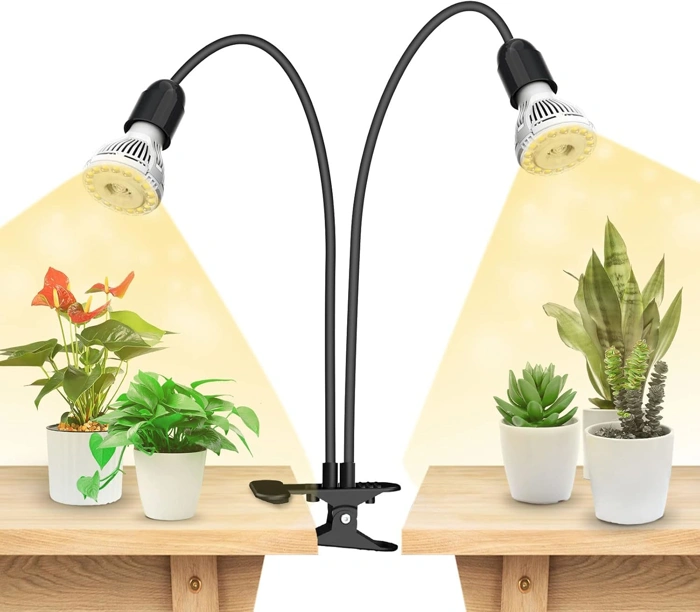
SANSI 300W Full Spectrum Dual Gooseneck Clip LED Grow Light
The SANSI 300W Full Spectrum Dual Gooseneck Clip LED Grow Light brings two adjustable heads to a single clip base, letting you aim light at separate zones or layer coverage over a denser plant grouping. The dual gooseneck design works well when you need to light a fiddle-leaf fig on one side and a cluster of pothos or philodendron on the other, or when you want to spread coverage across a shelf holding eight or more medium-sized plants.
Both necks bend independently, so you can adjust height and angle for each head without repositioning the entire fixture. The clip mounts to shelves, desk edges, or table rims the same way smaller single-head models do, keeping floor space clear and letting you tuck the light into corners or along walls.
Keep in mind that the 300 W figure is a marketing-equivalent rating. Actual power draw will be lower, so if you're calculating coverage or comparing output, check the true wattage specification rather than relying on the advertised number. This fixture suits established collections where you've moved past seedlings and cuttings into mature foliage that benefits from stronger, more distributed light.
The full-spectrum output supports both vegetative growth and flowering stages, though most houseplant growers will use it to maintain healthy leaves and encourage compact, bushy growth rather than to trigger blooms. If your setup includes a mix of low-light and medium-light plants, position the heads so each zone gets appropriate intensity - closer for ferns and calatheas, farther for succulents or hoyas.
This light works best when you already know your layout and have a stable shelf or surface to clip onto. The dual heads add weight, so confirm your mounting edge can support the fixture securely before leaving it unattended.
- ✅ Dual gooseneck heads let you target two zones or layer coverage
- ✅ Clip base keeps floor space clear and fits shelves or desk edges
- ✅ Full-spectrum output supports vegetative growth and foliage health
- ✅ Independent neck adjustment for flexible positioning
- ⚠️ 300 W is a marketing-equivalent rating; actual power draw is lower
- ⚠️ Dual heads add weight, requiring a sturdy mounting edge
- ⚠️ Best suited for established collections rather than seedlings
Common Mistakes to Avoid
Even experienced plant owners make preventable mistakes when selecting or using grow lights. Understanding these common pitfalls helps you avoid wasted money and disappointed plants.
Choosing wattage based on marketing claims instead of actual power draw. Many manufacturers advertise "1000W equivalent" lights that actually draw 100W from the wall. Always check the actual wattage or power consumption specification. A 20W LED that runs efficiently delivers more usable light than a 100W fixture with poor diodes. Compare actual draw and coverage area, not inflated marketing numbers.
Placing lights too far from plants. Most grow lights lose intensity rapidly with distance. A light positioned 36 inches above foliage may deliver only a fraction of the brightness it provides at 12 inches. For low-light plants, aim for 12 - 24 inches; for high-light tropicals and succulents, 6 - 12 inches is often ideal. If your plants stretch toward the light with long, weak stems, the fixture is too far away. Adjust height as plants grow to maintain consistent spacing.
Skipping timers and running lights 24/7. Plants need a dark period to complete their growth cycle. Constant light stresses foliage, causes leaf burn, and disrupts natural processes. Most houseplants thrive with 12 - 16 hours of light per day. Use an inexpensive plug-in timer to automate on/off cycles. This prevents both overexposure and the inconsistency that comes from manual switching.
Buying red/blue only lights for foliage plants. Early LED grow lights emphasized red and blue diodes because they match chlorophyll absorption peaks. But foliage plants benefit from a fuller spectrum that includes green and white wavelengths for balanced growth and natural appearance. Red/blue lights also cast an unnatural purple glow that makes it hard to spot pests or discoloration. For decorative houseplants in living spaces, choose full-spectrum white LEDs with a color temperature between 4000K and 6500K.
Ignoring form factor and available mounting points. A powerful panel light is useless if you have no way to hang it securely. Before purchasing, confirm you have the ceiling hooks, shelving clearance, or clamp points the fixture requires. Bulbs screw into standard desk lamps, clip lights attach to shelf edges, bars hang from cables, and panels need overhead support. Match the form factor to your actual furniture and mounting options, not just your plant count.
Setting Up for Success: Placement and Duration
Even the best grow light won't deliver results if it's positioned incorrectly or run on the wrong schedule. Most foliage houseplants thrive when the light sits 6 - 12 inches above the canopy, close enough to deliver useful intensity without causing heat stress or bleaching. Flowering plants and succulents often prefer 12 - 18 inches to accommodate their height and light appetite.
To check coverage, hold your hand at leaf level beneath the light. If you feel gentle warmth after 30 seconds, the distance is appropriate; if it feels hot, raise the fixture. As plants grow, adjust the height every few weeks to maintain that zone.
Duration matters as much as distance. Most tropical foliage plants do well with 12 - 14 hours of light daily, while flowering species and succulents may need 14 - 16 hours to stay compact and encourage blooms. A simple plug timer removes guesswork and ensures consistency, especially if your schedule varies.
Grow lights work best as a supplement to natural light rather than a total replacement. If your room receives a few hours of indirect daylight, position the fixture to extend that window into early morning or evening. Plants near north-facing windows or interior corners benefit most from this layered approach, gaining the spectrum and duration they need without the harshness of all-day artificial exposure.
Watch for signs that tell you to adjust: pale new growth or leggy stems suggest the light is too far or the duration too short, while crispy leaf edges or faded color can mean the fixture is too close or left on too long. Small tweaks - raising the light two inches, trimming an hour from the timer - usually bring plants back into balance within a week.
Final Takeaway
Choosing the right grow light for your houseplants doesn't require advanced knowledge or a big upfront investment. Start by assessing your space and the number of plants you want to support, then match the form factor to your furniture and room layout. For most apartment setups, a full-spectrum LED in the 20 - 30W range will cover a small to medium cluster of low- to medium-light plants without overwhelming your electrical usage or budget.
Use a timer to automate the light cycle - 12 to 16 hours per day works well for foliage plants - and monitor your plants for signs of too much or too little light. Leggy growth, pale leaves, or stretched stems suggest the light is too weak or too far away. Scorched leaf tips or bleached spots mean the fixture is too close or too intense.
If you're new to grow lights, start with one fixture over your least light-tolerant plants and expand as you gain confidence. You'll quickly learn how different species respond and what adjustments improve growth without creating stress. The decision framework is straightforward: space, plant count, spectrum, wattage, and placement. Master those five variables, and you'll have healthy, thriving houseplants year-round, even in low-light apartments.