We may earn a commission when you buy through links on this page, at no extra cost to you. How this works.
Most decorative moss poles cost under $20 and give climbing Monsteras the vertical support they need to grow larger, healthier leaves. Many plant owners delay adding a pole because the process seems complicated, but installation takes less than ten minutes and the difference in growth habit shows up within weeks. A well-chosen moss pole mimics the rough bark Monsteras cling to in their native rainforest habitat, encouraging aerial roots to attach and the plant to climb instead of sprawl.
Choosing the right pole comes down to three practical factors: height, flexibility, and whether you need a single pole or a multi-pack. Taller poles work for mature plants and reduce the need to add extensions later. Bendable poles fit into crowded pots more easily and allow you to adjust the angle as the plant grows. Multi-packs make sense if you have several Monsteras or other climbing aroids, since the per-pole cost drops and you can standardize your support system across plants.
This guide walks through how to evaluate moss pole options based on your Monstera's current size and growth stage, the steps to install a pole without disturbing roots, and how to train stems and aerial roots onto the surface. The goal is to match the pole to your plant's needs and set up a stable structure that supports natural climbing without constant adjustment.
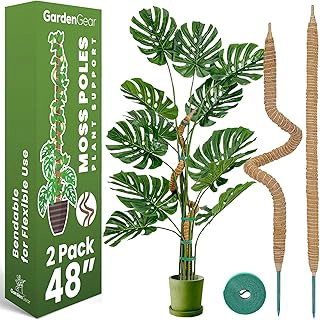
2 Pack 48'' Bendable Moss Pole for Climbing Monstera Plants
For Monsteras that have already gained height or spread outward in unexpected directions, the 48-inch bendable moss pole offers a practical way to support and guide growth without wrestling rigid stakes into place. Each pole in this two-pack can be shaped by hand to follow the natural curve of stems, making it easier to train plants that lean or have multiple climbing points. The coir surface gives aerial roots a textured grip, and the bendable core lets you adjust angles as the plant matures.
At the listed size, these poles work well for medium to large Monsteras that have outgrown shorter supports or need height for vigorous climbers. The bendability is especially helpful when working around furniture, corners, or pots where a straight pole would block light or crowd the space. You can arc the pole gently or leave it vertical - no tools or heat required. The two-pole pack at $14.99 gives you the option to outfit multiple pots or stack poles vertically if your Monstera continues upward.
With a 4.6 out of 5 rating, users report stable performance once inserted and note that the poles hold their shape after bending. Because these are bendable, they may feel slightly less rigid than solid wood or metal stakes, so if your Monstera is already top-heavy, you'll want to anchor the base firmly in the pot. For plants still establishing aerial roots, the flexibility makes positioning forgiving, and the coir encourages attachment over time without extra moss wrapping.
- ✅ 48-inch height suits medium to large Monsteras
- ✅ Bendable by hand to follow curved or angled growth
- ✅ Two-pole pack at $14.99 offers flexibility for multiple plants or stacking
- ✅ Coir surface encourages aerial root attachment
- ⚠️ Slightly less rigid than solid stakes if plant is top-heavy
- ⚠️ Requires firm anchoring in pot to maintain stability
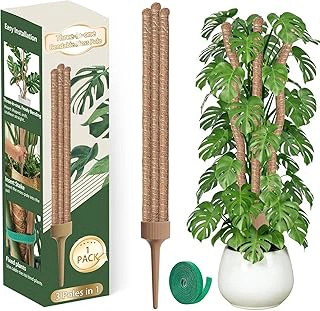
Set of 3 Bendable 30-Inch Tall Coir Moss Poles for Climbing Plants
If you're growing several smaller Monsteras or want to try moss poles across multiple plants without a large upfront cost, this three-pack offers practical flexibility at $14.99. Each pole stands the listed size tall, a compact height that fits plants in early climbing stages or spaces where ceiling clearance is tight. The bendable coir construction lets you adjust the angle to follow wandering vines or tuck the pole into a corner arrangement. Customers rate the set 4.7 out of 5, reflecting consistent quality across the pack.
The 30-inch height works well for plants whose aerial roots are just beginning to search for support, or for trailing pothos and philodendrons that don't need a towering structure. Because you receive three poles, you can test different anchoring methods in separate pots, support a bushier Monstera with multiple stems, or simply keep spares on hand as your collection grows. The bendable design means you can shape each pole to match the natural lean of a stem without forcing it upright, reducing the chance of snapping fragile growth.
At roughly five dollars per pole, the value proposition is strongest for apartment gardeners or anyone managing a cluster of small to medium plants. The compact footprint leaves room for other pots on a shelf or windowsill, and the coir surface provides enough texture for young aerial roots to grip as they thicken. If your Monstera is already several feet tall or you need a single statement piece, a taller pole will serve you better. For early support across multiple plants, this set delivers functional coverage without crowding your space or budget.
- ✅ Three poles for $14.99 offer strong value per unit
- ✅ 30-inch height suits plants in early climbing stages and tight spaces
- ✅ Bendable design adjusts to natural vine angles
- ✅ 4.7/5 customer rating reflects reliable quality across the pack
- ⚠️ Height may be insufficient for mature or tall Monsteras
- ⚠️ Shorter poles require replacement or stacking as plants grow
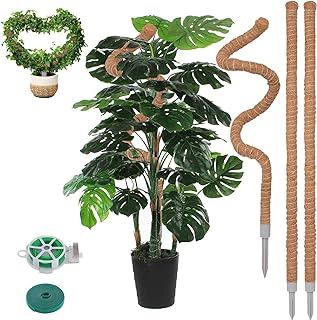
3 Pack 50 Inch Coco Coir Moss Pole for Monstera & Climbing Plants
Tall Monsteras and vigorous climbing plants need serious vertical reach, and this three-pack of 50-inch coco coir poles delivers the listed size of total support for $17.79. Each pole stands over four feet high, making this set ideal for mature specimens with substantial aerial root systems or multiple plants that have outgrown shorter stakes.
The coco coir construction holds moisture near the roots while providing a textured surface that aerial roots grip naturally. At 4.5 out of 5 stars, users appreciate the height and value when supporting large plants that would otherwise require multiple shorter poles stacked end-to-end. Three separate poles give you flexibility to distribute support across several plants or dedicate all three to a single vigorous climber trained along a wall.
This pack suits committed plant owners ready to provide long-term structure for established Monsteras, pothos, or philodendrons that have demonstrated strong vertical growth. If your plant is already leaning or trailing because shorter supports no longer match its ambition, the 50-inch height lets you anchor it securely without frequent upgrades. The three-pole format also means you can replace or reposition individual stakes as growth patterns shift, rather than committing to a single rigid trellis.
Consider this option when you need maximum height coverage without piecing together extension kits, and when the upfront cost of three tall poles fits your budget better than buying singles over time.
- ✅ 50-inch height provides serious vertical reach for tall or mature plants
- ✅ Three-pack offers 150 inches of total support for $17.79
- ✅ Coco coir retains moisture and gives aerial roots natural grip
- ⚠️ Height may be excessive for compact or young plants
- ⚠️ Requires deeper pots or external anchoring to stay stable
Why Your Monstera Will Love a Moss Pole
Monsteras evolved as climbers in tropical rainforests, using their aerial roots to grip bark and climb toward light. Without vertical support indoors, stems sprawl horizontally, leaves stay smaller, and the plant takes up more floor space than necessary. A decorative moss pole recreates the upward structure these plants expect, giving aerial roots a surface to anchor into while guiding growth vertically.
When a Monstera climbs, fenestration - the characteristic splits and holes in mature leaves - becomes more pronounced. The plant allocates more energy to leaf size and structure when it senses stable support, rather than producing longer, weaker stems that flop under their own weight. This isn't just aesthetic; vertical growth keeps the canopy organized and makes watering, pruning, and pest checks easier.
A moss pole also improves spatial efficiency. Instead of a Monstera sprawling across three feet of table or floor, the same plant trained upward occupies less than a square foot of footprint while reaching the same overall leaf mass. For apartment growers or anyone managing multiple plants in limited space, that vertical real estate matters.
Moss poles work because they hold moisture and texture. Aerial roots latch onto the rough surface, and if you mist or water the pole itself, roots absorb supplemental humidity. This mimics the damp bark Monsteras would grip in the wild, signaling the plant to invest in stronger attachment and upward growth rather than searching horizontally for something to climb.
What to Look For in a Decorative Moss Pole
Height matters more than most people think when picking a decorative moss pole. A 30- to 50-inch pole suits the majority of Monstera setups, giving climbing stems room to attach without forcing you to repot or add extensions within a few months. If you choose a shorter pole - say, 24 inches - you may need to stack a second one sooner than expected, which can create a wobbly joint unless you use a sturdy dowel insert. Taller poles above 48 inches demand deeper pots or external staking to prevent tipping as the plant gains weight.
Bendability becomes useful when you inherit a Monstera that has already sprawled horizontally or wound around furniture. A semi-flexible pole lets you curve the support gently around existing growth instead of forcing stems into unnatural angles. Rigid poles work well for vertical training from the start but offer no adjustment once installed.
Coir material holds moisture longer than plastic or foam wraps, which helps aerial roots latch on and stay hydrated between waterings. Natural coir also weathers more predictably; it softens and compacts over time rather than cracking or shedding microplastic fragments. The tradeoff is that coir can grow algae if your room stays humid and dim, though a quick wipe with diluted hydrogen peroxide usually clears it.
Pack size often tips the value equation. Multi-packs cost less per pole and let you stage several plants at once or keep a spare for future repotting. Single poles make sense only if you have one Monstera and no plans to expand your collection. Check whether the pack includes plant ties or stakes; many decorative poles ship as bare posts, leaving you to hunt for velcro strips or twine separately.
Step-by-Step Guide: How to Install a Moss Pole
Installing a moss pole works best during repotting, when you can position it without damaging roots. If you're working with an established plant, water the soil a day this product so it's easier to work with and less likely to compact around tender roots.
Start by identifying the main stem of your Monstera - this is where most aerial roots emerge and where the plant naturally wants support. Push the base of the pole 3 to 4 inches into the soil, about two inches away from the stem. Angling the pole slightly toward the plant's natural lean helps the stem rest against the surface without forcing it into an awkward position.
Pack soil firmly around the base, pressing down in a circular motion to eliminate air pockets. The pole should feel secure when you gently tug the top; if it wobbles, add more soil or push it deeper. Once stable, use soft ties or plant clips to attach the stem and any wandering aerial roots to the pole, spacing them a few inches apart. Avoid pulling the stem too tightly - you want contact, not tension.
If you're installing the pole in a pot that's already crowded with roots, work slowly and use a chopstick or pencil to create a pilot hole before inserting the pole. This reduces the risk of tearing roots and makes placement more controlled.
How to Gently Attach Your Monstera to the Pole
Once your moss pole is firmly in place, the next step is securing your Monstera to it without causing harm. Start by identifying the main stem or stems you want to train upward. Use soft plant ties, garden velcro, or flexible fabric strips to attach the stem to the pole at roughly six to eight-inch intervals. These materials distribute pressure evenly and prevent the kind of cutting or pinching that wire or thin string can cause as the plant expands.
The key is to tie loosely enough that the stem has room to thicken. A tie that feels snug today can become a constriction point in a few weeks, so leave a small gap between the tie and the stem. Your goal is to hold the plant in position, not to clamp it down. Over time, the Monstera's aerial roots will reach out and grip the moist surface of the pole on their own, creating a natural anchor that requires less intervention.
As you work your way up the stem, gently guide any visible aerial roots toward the pole. You don't need to force them into the moss or coir; simply pointing them in the right direction is enough. The roots will sense the moisture and texture and begin to attach themselves. This process takes weeks, not days, so patience is part of the routine.
Check your ties every few weeks, especially during the growing season when stems thicken quickly. Loosen or replace any that look tight, and add new ones as fresh growth extends beyond the last tie point. This monthly habit prevents damage and keeps your Monstera climbing smoothly without stress to the plant.
Caring for Your Moss Pole and Climbing Plant
Coir poles work best when they stay consistently moist, which encourages aerial roots to grip and climb naturally. Mist the pole every few days with a spray bottle, focusing on the textured surface where roots make contact. If your home runs dry, consider misting daily during the growing season to keep the fibers damp without soaking the potting mix.
Check the ties or twist ties every two to three weeks as your Monstera adds new growth. Stems thicken over time, and ties that were snug at installation can begin to pinch or restrict circulation. Loosen or replace them as needed, and guide new leaves toward open sections of the pole so the plant climbs evenly rather than bunching at one height.
Watch for signs that your pole is reaching capacity. When the top third fills in with foliage and new growth pushes past the highest tie point, it's time to add an extension pole or move the plant to a taller support. A pole that's too short forces stems to arch or flop, undoing the vertical structure you've worked to build.
Once the pole and plant are established, maintenance becomes routine. A quick mist, a glance at the ties, and occasional dusting of the leaves are enough to keep the system stable. Moss poles don't require fertilizer, special cleaning, or seasonal adjustments - they simply provide a surface for the plant to do what it naturally does in the wild.
Final Thoughts
A decorative moss pole is one of the simplest upgrades you can make for a climbing Monstera, and the cost is minimal compared to the difference it makes in growth direction and overall appearance. Most installations take less than 15 minutes, even if you're working with a larger plant that needs careful repositioning. Once the pole is secure and the aerial roots have contact with the moss, you'll start to see the plant adjust its growth pattern within a few weeks.
Choose a height that gives your Monstera room to climb without overwhelming the pot. If you're working with a young plant, a 24- to 30-inch pole is usually enough for the first year or two. Larger specimens do better with 36-inch or taller poles, especially if you want to avoid adding extensions later. Consider whether you want a single pole or a multi-pack if you have several climbing plants that need support.
Installation doesn't require special tools or experience. Push the stake deep enough that it won't shift when the plant gains weight, position it close to the main stem, and use soft ties to guide the vines without cutting into tissue. Keep the moss lightly moist during the first month so the aerial roots make good contact, then settle into a routine that matches your watering schedule. The plant will do the rest, attaching itself as it grows and developing a more upright, compact shape that shows off the fenestrations.