We may earn a commission when you buy through links on this page, at no extra cost to you. How this works.
Houseplant Health Meter – 3-in-1 Tool to Prevent Overwatering, Root Rot & Leaf Burn - Test Soil Moisture, Sunlight & pH - Simple, Easy, Battery-Free - Suitable for Indoor, Outdoor & Potted Plants
Stop killing plants with guesswork. These moisture meters show exactly when to water.
Use the matching tool first
Start with Houseplant Watering Confidence Calculator if you want to narrow the fit before checking current offers.
Most indoor plants die from overwatering, not neglect. When roots sit in soggy soil, they suffocate and rot, turning healthy greenery into a wilted mess before you realize what went wrong. Finger-testing the top inch of soil works in shallow pots, but deeper containers hide wet pockets that drown roots while the surface feels dry.
Moisture meters eliminate that guesswork for $8.97 to $30.98. These tools measure water levels several inches down, showing you exactly when your plant needs a drink and when it doesn't. If you've ever felt guilty watching a favorite plant decline despite your best efforts, a meter builds the confidence to water based on data instead of doubt.
The five meters in this guide range from basic analog probes that deliver instant readings to digital models with backlit displays and calibration features. Analog versions cost less and never need batteries, while digital options offer precision for collectors managing dozens of plants with different moisture needs. Each option addresses the same core problem: helping you stop killing plants by giving them too much water when they needed air at the root zone instead.
How a Moisture Meter Can Save Your Plants
Overwatering kills more indoor plants than pests, poor light, or forgotten fertilizer combined. A moisture meter eliminates guesswork by measuring water content where it matters most - down at the root zone - rather than relying on the dry surface layer that can hide saturated soil underneath.
Analog moisture meters use a metal probe to read moisture through soil conductivity, displaying results on a color-coded dial without batteries or setup. You push the probe into the potting mix, wait ten seconds, and read the scale: red for dry, green for moist, blue for wet. These models are instant, portable, and sold in multi-packs for under ten dollars.
Digital moisture meters add numeric readouts, often paired with pH and light sensors on a backlit LCD screen. They require a battery but provide precise soil pH levels and lux measurements alongside moisture percentages. If you're troubleshooting finicky tropicals or managing a large collection with varied watering schedules, the extra data helps you adjust care plant by plant.
The real value is prevention. Consistently wet soil below the top inch suffocates roots, triggering the brown, mushy rot that spreads faster than most beginners expect. A meter gives you confidence to wait when the surface looks dry but the root ball is still damp, or to water deeply when the probe reads red three inches down. Budget two-packs work well if you need quick checks across multiple pots, while multi-function tools make sense when light exposure or pH swings are part of the problem you're solving.
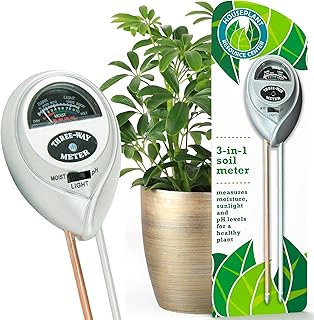
Houseplant Health Meter – 3-in-1 Tool to Prevent Overwatering, Root Rot & Leaf Burn - Test Soil Moisture, Sunlight & pH - Simple, Easy, Battery-Free - Suitable for Indoor, Outdoor & Potted Plants
New plant owners often struggle to balance moisture, light exposure, and soil chemistry all at once. This 3-in-1 analog meter tackles that challenge by reading moisture levels, sunlight intensity, and pH on three separate dial scales - no batteries required. At $22.85, it sits between budget single-function probes and premium digital monitors, making it a practical pick if you want multiple data points without managing power or calibration.
The analog design uses a single probe that you insert into the soil; three needle dials on the face display moisture (dry to wet), light (low to high), and pH (acidic to alkaline). Because the meter operates mechanically, there are no batteries to replace and no screen to fade in bright sun. You simply push the 8-inch probe into the root zone, wait about sixty seconds, and read the needles. The moisture scale runs from 1 (dry) to multiple (wet), the light scale measures ambient Amazon.com: Houseplant Health Meter – 3-in-1 Tool to Prevent Overwatering, Root Rot & Leaf Burn | Test Soil Moisture, Sunlight & pH | Simple, Easy, Battery-Free | Suitable for Indoor, Outdoor & Potted Plants: Patio, Lawn & Garden in foot-candles, and the pH scale spans roughly the listed amount.
This meter works well when you're learning which plants need acidic soil and which prefer neutral conditions, or when you're trying to diagnose why a fern thrives near a north window but a succulent does not. The three-dial format gives you context: if the moisture needle shows wet but the plant looks wilted, you can check whether pH is off or light is insufficient. That cross-reference helps you avoid guessing and helps reduce the chance of the cycle of overwatering that leads to root rot.
The tradeoff is precision. Analog needles offer general guidance rather than exact numeric readouts, so the pH scale is best understood as a range - acidic, neutral, or alkaline - rather than a laboratory-grade measurement. The light reading is also relative; it tells you whether a spot is dim, moderate, or bright, but it won't replace a dedicated lux meter if you need to hit a specific intensity for high-light tropicals. For most houseplant care, that level of detail is enough to make informed watering and placement decisions.
Durability depends on how you handle the probe. Forcing it into compacted or rocky soil can bend the metal sensor, and leaving it buried between readings may corrode the contacts over time. Pull the probe out after each check, wipe it clean, and store it dry. The plastic housing around the dials is lightweight, so dropping the meter onto tile or concrete can crack the face.
With a 4.2 rating, this meter appeals to beginners who want a straightforward way to monitor three variables without juggling separate tools or remembering to charge a device. If you already own a reliable moisture-only probe and rarely adjust pH, the extra dials may feel redundant. But if you're still figuring out why some plants flourish and others fail, having moisture, light, and pH feedback in one glance can shorten your learning curve and reduce the risk of overwatering.
- ✅ Three separate analog scales for moisture, sunlight, and pH in one tool
- ✅ No batteries required - mechanical operation for long-term reliability
- ✅ 8-inch probe reaches the root zone in medium and large pots
- ✅ Clear dial layout helps diagnose multiple issues at once
- ⚠️ Analog needles provide general ranges rather than precise numeric values
- ⚠️ Probe can bend if forced into compacted or rocky soil
- ⚠️ Lightweight plastic housing may crack if dropped on hard surfaces
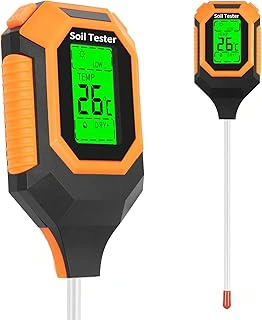
4-in-1 Soil Moisture Meter with Digital PH, Plant Temp, Sunlight, Backlight LCD
For plant owners who want detailed, numeric data they can track over time, this meter combines four sensors in a single probe. The backlit LCD screen displays moisture level, pH balance, temperature, and ambient light - all as numbers rather than colored zones. If you grow plants in low-light rooms, basements, or closets, the backlight makes it possible to read results without a flashlight.
The moisture scale runs from multiple, which gives you finer resolution than a three-zone analog dial. You can note that a plant sits at multiple on Monday and multiple on Thursday, then adjust watering intervals accordingly. The pH range covers multiple, useful if you're mixing your own potting media or growing species that need acidic soil. Temperature reads in Fahrenheit or Celsius, and the light sensor reports in foot-candles - helpful for checking whether a windowsill actually delivers the bright indirect light a label promises.
At $30.98, this is the highest-priced option in the group. You pay extra for the digital readouts and the backlight circuitry. The unit requires a 9-volt battery (not included), so ongoing cost is slightly higher than the single-probe analog meters that need no power. The plastic casing feels lighter than the metal housing on analog models, and the longer probe length - around eight inches - works well in tall nursery pots but can be awkward in shallow planters. Rated 4.2 out of 5, most users appreciate the data logging capability, though a few note the pH sensor can drift after several months of use in very wet soil.
This meter suits growers who keep a plant journal, manage mixed collections with different pH needs, or want to document conditions before troubleshooting yellowing leaves or stunted growth. If you only need to know wet, moist, or dry, a simpler analog meter will save you twenty dollars. But if precise numbers help you make watering decisions with confidence, the backlit screen and four-function design deliver the detail you're looking for.
- ✅ Backlit LCD readable in dim rooms and closets
- ✅ Numeric moisture scale (0 - 10) for tracking trends over time
- ✅ Four sensors: moisture, pH, temperature, and light in one probe
- ✅ Switchable Fahrenheit or Celsius temperature display
- ⚠️ Highest price at $30.98
- ⚠️ Requires 9-volt battery (not included)
- ⚠️ Longer probe can be awkward in shallow containers
- ⚠️ pH sensor may drift after months of exposure to wet soil
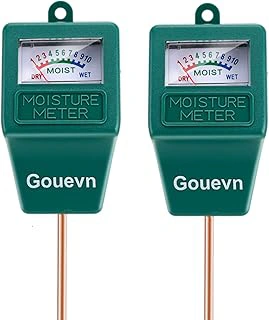
Gouevn 2-Pack Soil Moisture Meter for Indoor & Outdoor Plants
At $12.99, this two-pack splits the cost to roughly the listed amount per meter, making it easy to station one in a thirsty fern and another in a succulent pot without juggling a single tool across your collection. The analog design reads moisture instantly on a color-coded scale - no batteries, no buttons, just insert the probe and check the needle. That simplicity suits routine checks and lets you leave a meter in place if you're monitoring a plant recovering from overwatering.
The trade-off is function: you get moisture only, no pH or light readings. If you need a full three-in-one diagnostic, look elsewhere. But for growers focused on preventing root rot by catching wet soil before it turns anaerobic, the single-function approach removes unnecessary complexity. The 4.4 rating reflects consistent performance across indoor and outdoor use, though probe care matters - wipe the metal clean after each reading and avoid forcing it into compacted or rocky soil.
Two meters also mean you can compare readings side-by-side in different pot zones or keep one as a backup when the first wears out. The upfront cost covers both, so there's no second purchase when you expand your plant count or want redundancy in high-stakes situations.
- ✅ Two-pack value at roughly $6.50 per meter
- ✅ Analog design with instant color-coded readings
- ✅ No batteries required
- ✅ Suitable for leaving in place to monitor recovery
- ⚠️ Moisture only - no pH or light measurement
- ⚠️ Probe requires cleaning and gentle handling in rocky soil
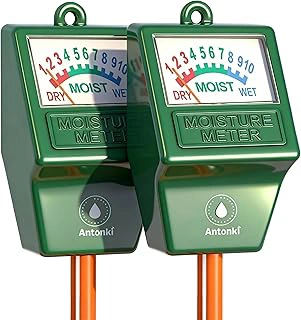
Antonki 2-Pack Soil Moisture Meter for Indoor & Outdoor Plants
The Antonki 2-Pack Soil Moisture Meter comes in at $8.97, making it the lowest-cost option in this guide and a practical choice if you want to try moisture measurement without upfront commitment. You get two meters in the package, so you can monitor multiple plants or keep one as a backup. The analog design uses a simple color scale from red (dry) through green (ideal) to blue (wet), readable at a glance once you insert the probe into soil.
This meter measures moisture only - no pH or light functions - and requires no batteries. Push the larger probe into the root zone, wait about ten seconds, and the needle settles on a reading. The streamlined approach works well for someone testing whether a moisture meter will become part of their regular routine. Because it skips the extra sensors and digital components, the tool stays straightforward: you water when the needle lands in the red zone and hold off when it's in green or blue.
The trade-off for the low price is basic functionality. You won't get numeric precision or data logging, and the analog dial can stick occasionally if soil packs tightly around the probe. The 4.4 out of 5 rating matches pricier options like the Gouevn, indicating that affordability doesn't always mean lower user satisfaction. For Chloe - or anyone new to moisture meters - this two-pack offers a budget-friendly entry point to see if the tool changes watering habits before investing in a model with more features.
- ✅ Lowest price at $8.97 for two meters
- ✅ No batteries required
- ✅ Simple color-coded scale for quick visual readings
- ✅ Good starter option to test the tool category
- ⚠️ Moisture measurement only - no pH or light sensor
- ⚠️ Analog dial may stick in dense or compacted soil
- ⚠️ No numeric precision or data tracking
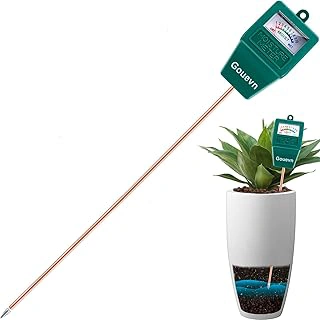
Gouevn Long Probe Soil Moisture Meter for Indoor & Outdoor Plants
Reaching the root zone in deep containers often means guessing whether the bottom half of the soil is still waterlogged while the surface feels dry. The Gouevn Long Probe Soil Moisture Meter addresses this gap with an extended probe designed to reach deeper into large floor planters and tall outdoor pots where standard multiple- to larger probes fall short.
This analog meter operates without batteries, using a simple dial readout that moves from dry to moist to wet as you insert the probe. Because it measures only moisture - no pH or light - the design remains straightforward: push the probe into soil until you reach the depth of the root ball, wait ten seconds, read the dial, then pull it out and wipe it clean. For fiddle leaf figs, snake plants in tall planters, or outdoor container trees, the extra length lets you check whether water is actually penetrating to where roots live.
At $9.99, you receive one meter rather than a two-pack, which means you'll be moving it from pot to pot instead of leaving one in place. The trade-off suits gardeners who manage a smaller number of large plants and need the probe length more than convenience. The 4.4 rating reflects reliable function in deeper soil, though a few users note the dial can stick if the probe isn't cleaned after each use.
If your collection includes floor plants or you're planning to add larger specimens that require watering deeper than surface level, the extended probe becomes the practical choice over standard-length alternatives. For smaller desktop pots or succulents in shallow dishes, a shorter, multi-pack meter will be easier to handle and more cost-effective per unit.
- ✅ Extended probe reaches deep root zones in large floor planters and tall containers
- ✅ Battery-free analog dial requires no power source or setup
- ✅ Single-function moisture reading keeps operation simple and focused
- ✅ Affordable at $9.99 for gardeners with a few large plants
- ⚠️ Single meter instead of multi-pack requires moving between pots
- ⚠️ Dial can stick if probe isn't wiped clean after each reading
- ⚠️ Extra length less useful for small desktop plants or shallow containers
How to Use a Moisture Meter Correctly
Insert the probe about two-thirds of the way down into the soil, aiming for the root zone rather than just the top inch where moisture evaporates quickly. Push it in at a slight angle near the edge of the pot, staying clear of the center stem and main roots to avoid accidental damage.
Wait a full 60 seconds before reading an analog meter. The needle needs time to settle as it reacts to moisture levels through conductivity. Reading too early often shows a false dry signal, leading to overwatering. Digital meters typically stabilize faster, but checking the manufacturer's recommendation helps ensure accuracy.
Most analog meters use a three-zone color system: red indicates dry soil where watering is needed, green shows adequate moisture, and blue signals wet conditions where roots may lack oxygen. Water when the needle drops into the red zone, not while it's still green. The meter shows the current moisture state at that moment, not a prediction of when the plant will need water next.
Wipe the metal probe with a dry or slightly damp cloth after each use. Soil particles and mineral deposits left on the surface cause corrosion over time, which throws off readings. For plants with inconsistent watering patterns or large containers, test two or three spots around the perimeter to get a complete picture before deciding whether to water.
Common mistakes include inserting only an inch deep, reading immediately, and trusting a single measurement in a big pot. Taking the time to probe deeper, wait longer, and check multiple locations turns the meter into a reliable tool rather than another source of guesswork.
Quick Comparison: Which Moisture Meter Fits Your Needs?
- Under $10 and just starting out? Antonki 2-pack at $8.97
- Need two meters for multiple plants? Gouevn 2-pack at $12.99
- Want pH and light data without batteries? Houseplant Health Meter at $22.85
- Prefer digital readouts and backlight? 4-in-1 Digital at $30.98
- Have large floor plants or deep pots? Gouevn Long Probe at $9.99
Frequently Asked Questions About Soil Moisture
New plant owners often wonder whether their moisture meter requires setup or calibration before use. Most analog models arrive factory-set and work immediately after you unbox them - just push the probe into soil and read the dial. Digital meters may need a battery check, but they also skip calibration in typical home use.
Leaving a probe in the soil around the clock sounds convenient, but it shortens the tool's life. Moisture, fertilizer salts, and organic acids corrode metal probes over time, weakening conductivity and accuracy. Pull the probe out as soon as you have a reading, wipe it clean, and store it dry.
Readings that jump from dry to wet across the same pot are normal, not a sign of malfunction. Soil moisture varies with root density, distance from drainage holes, and proximity to the pot wall. Check three or four spots around the perimeter and center, then decide based on the driest zone near active roots.
Checking frequency depends on season, pot size, and plant type. Start with every few days to learn each plant's rhythm, then stretch to weekly once patterns become predictable. Fast-draining succulents in terracotta need less frequent checks than moisture-loving ferns in plastic nursery pots.
Moisture meters handle standard potting mix, cactus blend, and even dense garden soil without trouble. Very chunky media - orchid bark, large perlite, or lava rock - may leave air gaps around the probe and produce inconsistent readings. In those cases, lift the pot to judge weight or rely on visual cues alongside occasional meter checks.